Water stains on the ceiling. A damp smell in a bedroom. Paint that bubbles after a rainy night. If your roof is leaking in Dubai, you are not alone — and you are not helpless. This guide explains why roofs leak here, what to do first, why quick patches usually fail, and how a leak is fixed so it does not come back. It is written from experience: our team has completed more than 1,500 waterproofing projects across the UAE.
The five signs of a leaking roof
Most owners never see the leak itself. They see what the water leaves behind:
- Brown or yellow stains on the ceiling, often in rings that grow after rain.
- Bubbling or flaking paint on a ceiling or the top of a wall.
- A damp, musty smell in one room, strongest in the morning.
- Hairline cracks with dark edges where water has moved through.
- Standing water on the roof that is still there a day after rain.
One of these signs is enough to act. Water damage grows quietly — by the time a stain is visible, the water has already been inside the structure for some time.
Why do roofs leak in Dubai?
Most villa roofs in the UAE are flat concrete roofs. They are strong, but the waterproofing layer on top has a hard life here:
- Extreme heat. A roof surface in Dubai can reach 80 °C in summer. The roof expands during the day and shrinks at night. Year after year, this movement opens small cracks in old waterproofing layers.
- UV radiation. Strong sun breaks down bitumen sheets and cheap coatings. They become brittle and crack.
- Rare but heavy rain. It does not rain often in the UAE — but when it rains, a lot of water comes at once. A flat roof holds this water for hours, and every weak point is found. You can follow official warnings at the UAE National Center of Meteorology.
- Joints and details. Most leaks do not start in the middle of the roof. They start at parapet walls, AC unit bases, pipe openings, drains and skylights — the places where a rolled sheet membrane has seams.
- Age. Many villas still have their original waterproofing from construction. After 10 to 15 years, it has simply reached the end of its life.
The hidden problem: water travels
The wet spot on your ceiling is rarely under the hole in the roof. Water enters through a crack, runs along the concrete slab, and appears somewhere else. The real entry point can be metres away from the stain. This is why patching the spot above the stain so often fails — and why finding the true entry point needs experience with how water moves through a roof build-up.
What to do first: five steps
- Keep everyone safe. If water is near a light fitting or electrical socket, switch off the power for that room first.
- Contain the water. Place a bucket under an active drip and move furniture and electronics away.
- Document it. Take photos of the stain and note when it appeared. Was it after rain? After the garden irrigation ran? After AC condensation increased in summer? These details help the inspection enormously.
- Do not paint over it. Fresh paint hides the evidence and traps moisture in the ceiling. The stain will return, usually bigger.
- Book a professional inspection. A good inspection checks the whole roof, not just one spot, and tells you honestly whether a repair is enough or the waterproofing layer has reached its end. Ours is free of charge.
One warning: do not climb onto a wet roof during or right after rain. A flat roof with standing water is slippery, and nothing about a leak improves by standing in the rain above it.
Why quick patches usually fail
A tube of sealant or a patch of bitumen sheet can stop one drip for one season. But it does not solve the reason the roof leaked: the waterproofing layer as a whole has failed. The next crack opens somewhere else, and every repair adds another seam — another future weak point.
If a roof has leaked once and the membrane is old, patch repairs become a yearly routine. Over a few years, this costs more than doing it properly once.
The permanent fix: a seamless liquid membrane
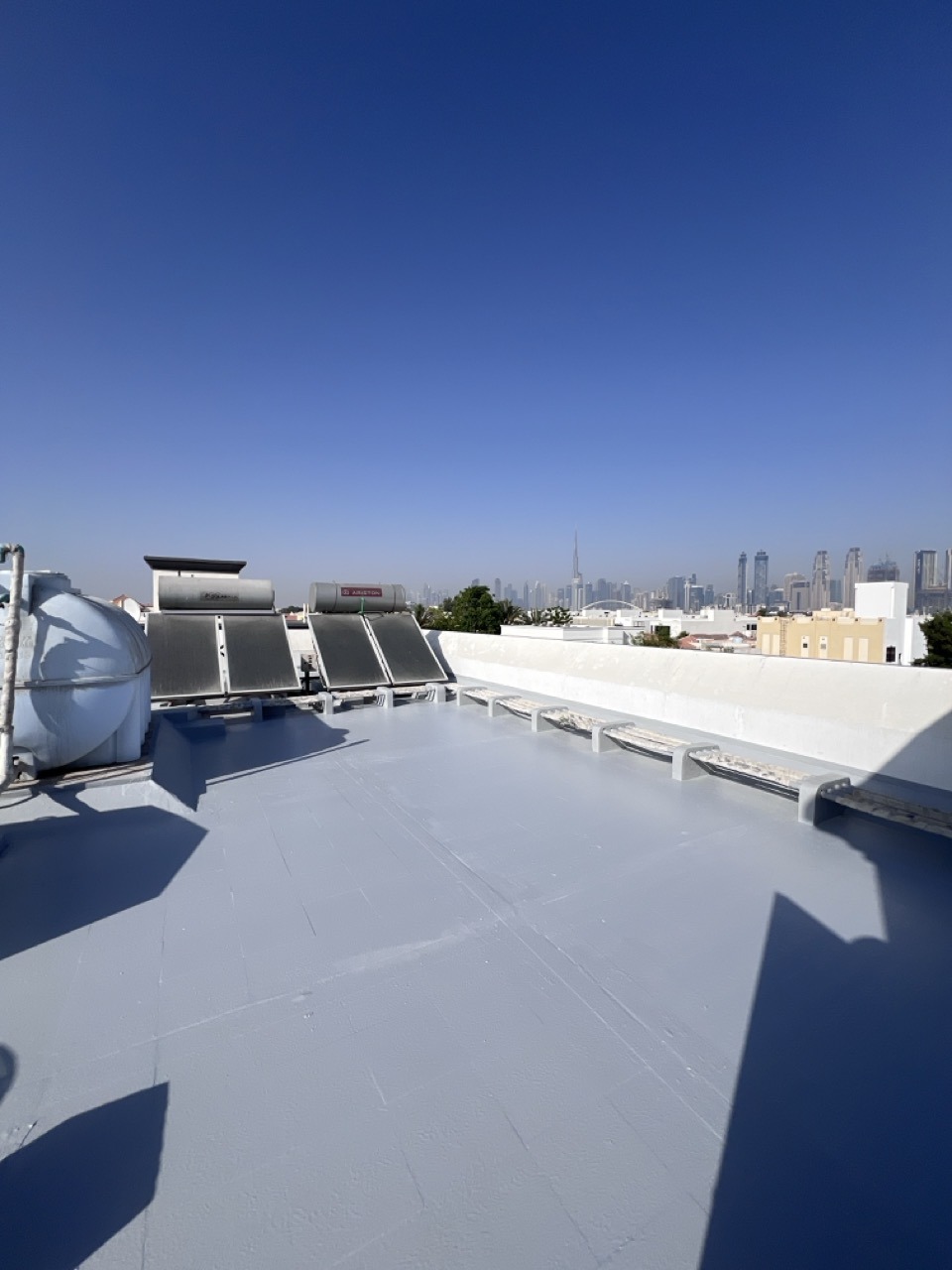
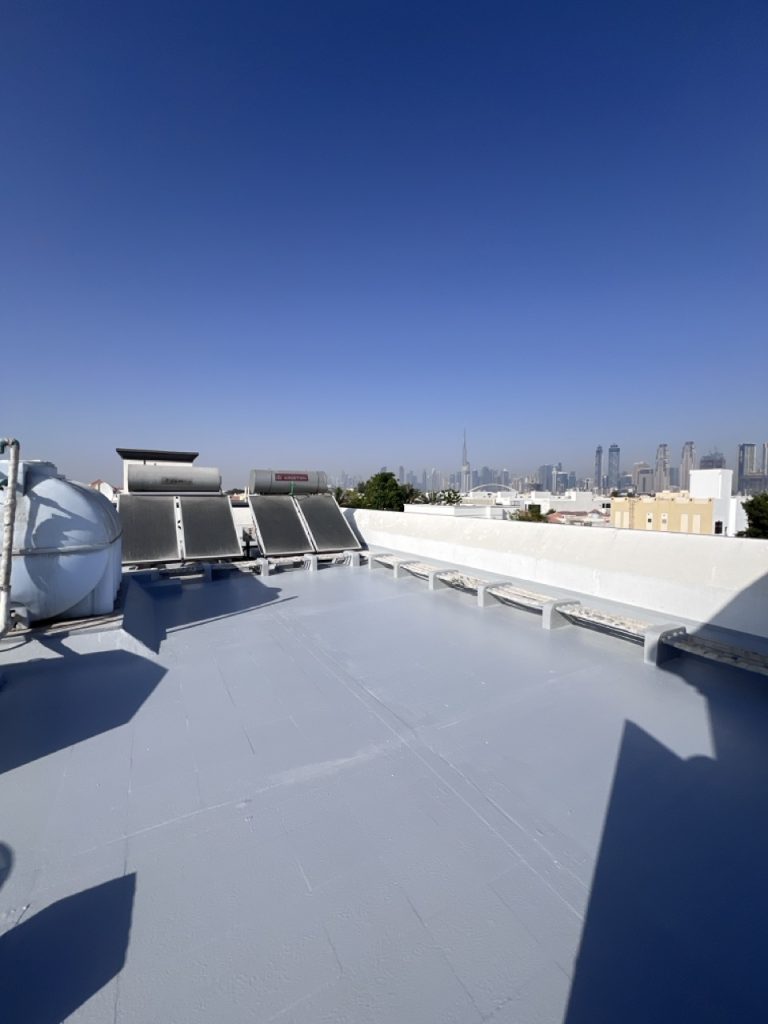
Modern roof waterproofing does not use rolled sheets with seams. It uses a liquid membrane that is applied across the whole roof and cures into one seamless, elastic layer. We work with Frankosil 1K, a German liquid waterproofing system made by Franken Systems, because it solves exactly the problems Dubai roofs have:
- No seams. The liquid flows around every pipe, drain, AC base and parapet detail. The most common leak points disappear.
- Stays elastic. The cured membrane moves with the roof through the daily heat cycle instead of cracking.
- Handles UAE conditions. Made in Germany and proven on UAE roofs that reach 80 °C surface temperature in summer.
- 20-year warranty. We stand behind the system in writing. One application, two decades of protection.
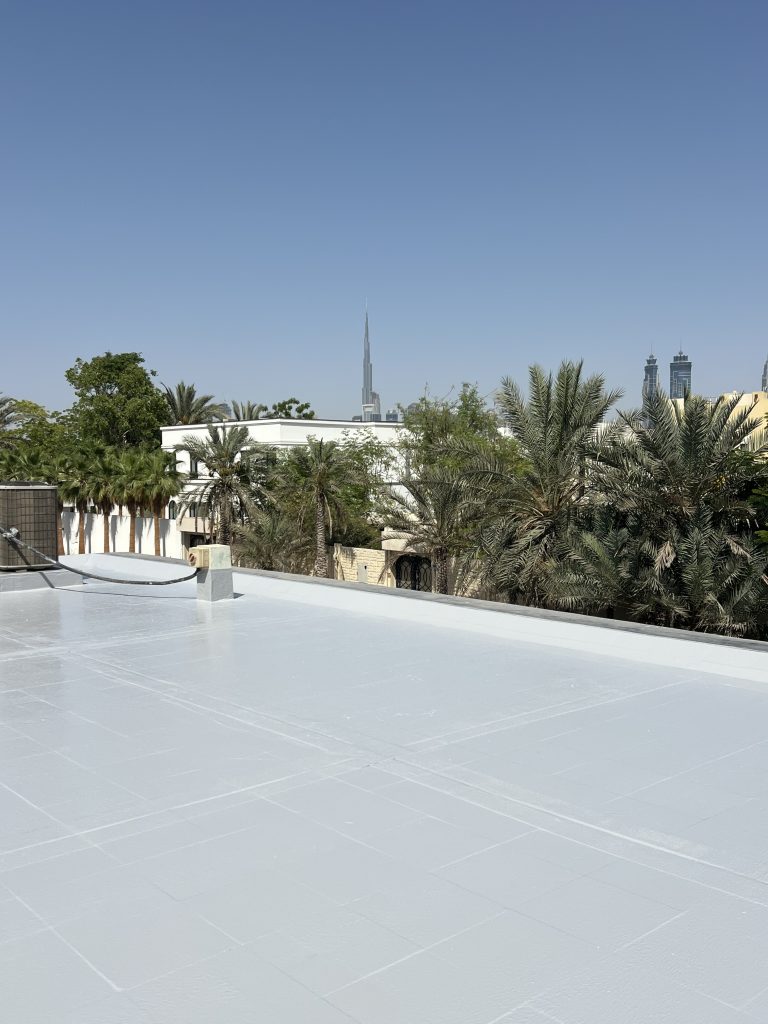
You can see completed villa roofs, terraces and warehouse projects on our showcase page.
How the process works
- Free site inspection. A specialist visits your villa, inspects the full roof and all detail points, and measures the area.
- Clear quote. You receive a written quote for the complete work. No surprises later.
- Preparation. The roof is cleaned and prepared. Old loose material is removed where needed.
- Application. The liquid membrane is applied across the whole roof, including all details and connections.
- Handover with warranty. You receive your completion documents and the 20-year warranty.
Frequently asked questions
My ceiling is stained but it has not rained. Where is the water from?
Common sources are AC condensation lines, water tank overflows, irrigation spray hitting a parapet wall, and bathroom pipes in the slab. An inspection identifies the source before any roof work is recommended.
How much does roof waterproofing cost in Dubai?
It depends on the roof size, the condition of the old layer, the number of details (AC units, pipes, skylights) and the preparation needed. That is why we measure first and quote after — the site inspection and the written quote are free, and the price you receive is complete.
Can I fix a roof leak myself?
You can slow it down — clear the roof drains, remove standing water, and cover a visible crack temporarily. A permanent fix needs the real entry point found and the membrane restored as one continuous layer. That is specialist work with specialist material.
Can you waterproof over the old layer?
Often yes. If the old membrane is sound and well bonded, the liquid system can be applied on top after preparation. If it is loose or water is trapped underneath, it must be removed first. The inspection decides this honestly.
How long does the work take?
A typical villa roof takes a few days, depending on size, preparation and curing time between coats. You can stay in the house during the work.
Does the villa need to be empty?
No. All work happens on the roof. Access is needed only to the roof itself.
Book a free roof inspection
If you have seen a stain, a crack or standing water, do not wait for the next rain. A free inspection tells you exactly what your roof needs — with honest advice on whether a repair is enough or a new membrane makes sense.
Book your free site inspection here — or send us a message on WhatsApp and our team will arrange a visit.