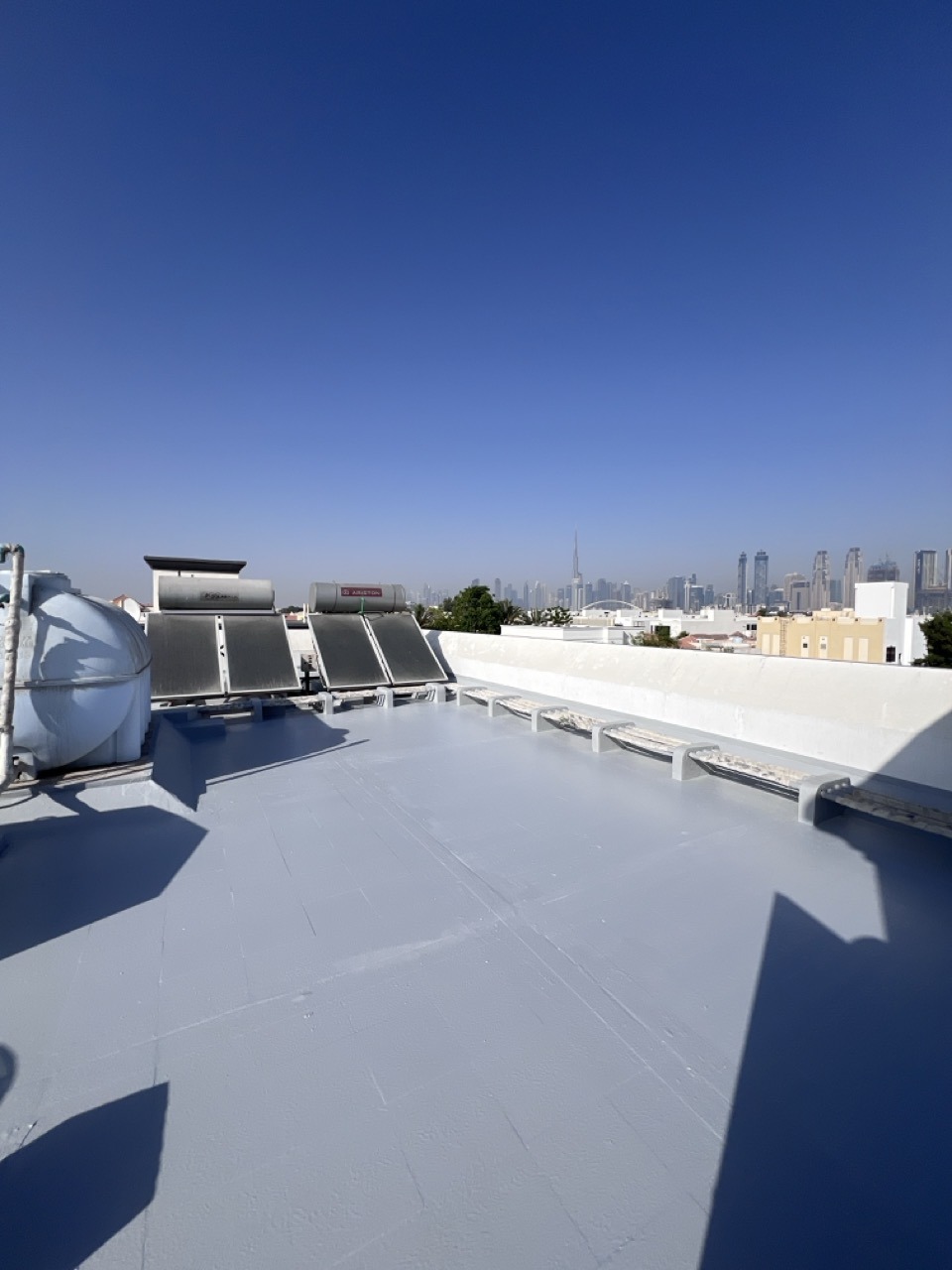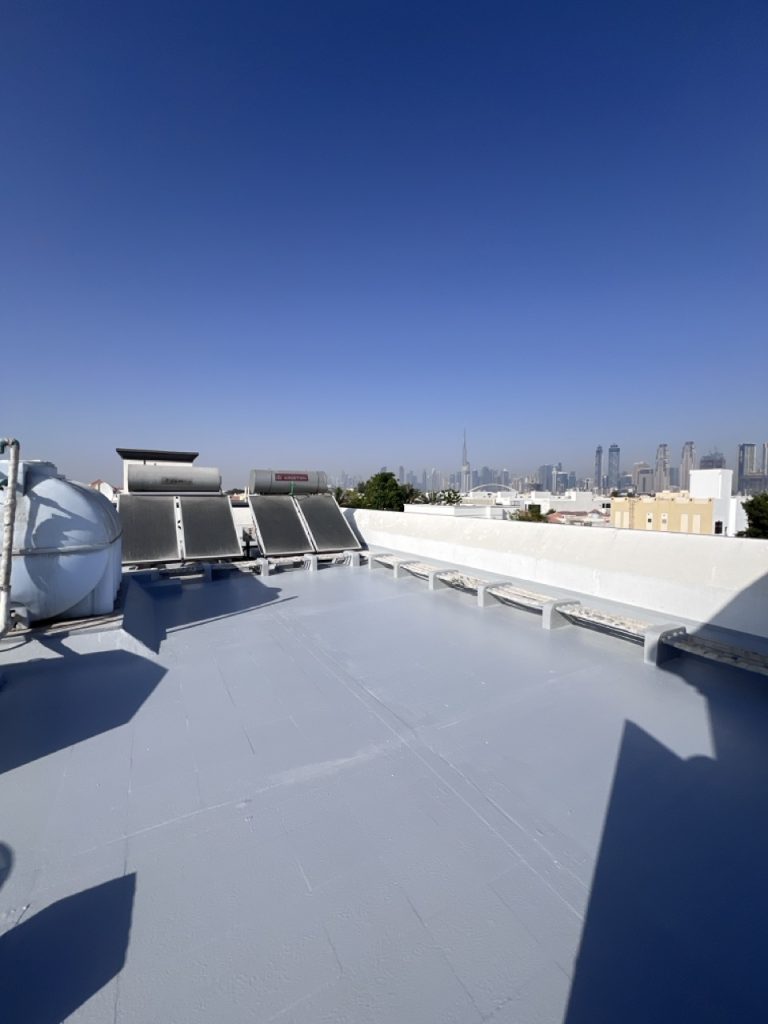
Villa roof maintenance in Dubai is the one job most owners never think about — until a stain appears on a ceiling. A flat concrete roof gives no warning. It looks the same the day before a leak as it did a year earlier. This guide explains what to check, when to check it, and what an owner can do without climbing onto the roof. It is written from experience: our team has completed more than 1,500 waterproofing projects across the UAE.
Why a Dubai villa roof needs yearly maintenance
The roof is the hardest-working surface on your villa, and here it works under conditions most building materials were never designed for.
- Heat. A roof surface in Dubai reaches 80 °C in summer. The slab expands through the day and contracts at night. That movement never stops, and over years it opens small cracks in the waterproofing layer.
- UV radiation. Constant strong sun makes bitumen sheets and thin coatings brittle. Brittle material cracks.
- Dust. Fine sand collects in the drains all year. A blocked drain turns a flat roof into a shallow pool the next time it rains.
- Short, heavy rain. It rains rarely here, but a large amount of water arrives at once. That is the moment every weak point is tested together.
None of this damages a sound roof in one year. All of it damages a neglected roof over several. A yearly check is what keeps small work small.
The best time for the check: before the rain season
Rain in the UAE falls mainly between November and April. The right time to inspect a roof is therefore September or October — before the first rain, while the roof is dry and every detail is easy to reach and easy to see.
Checking after the first heavy rain is late. By then water has found the weak point, and often already reached the concrete. Official rain and storm warnings are published by the UAE National Center of Meteorology.
One extra inspection is worth doing: after any unusually heavy rain, while the evidence is still wet.
The yearly roof check: what a specialist looks at
A proper inspection is not a walk across the middle of the roof. The middle is rarely the problem. These are the points that matter, roughly in the order they cause trouble:
- Parapet walls and the joint at their base. The line where the flat surface turns up into the wall moves most and cracks first.
- Drains and outlets. Are they clear, and does the roof still fall towards them? A drain sitting higher than the surface around it guarantees standing water.
- AC unit bases and their pipe penetrations. Every unit stands on a plinth, and every plinth had to be sealed by hand.
- Pipe openings, cable entries and vents. Anything passing through the roof is a hole that was closed afterwards.
- Skylights and roof hatches. Frames move differently from concrete, so their seals age faster than the roof.
- The membrane surface itself. Cracks, blisters, chalky powder, exposed fabric, or sheet edges that have lifted.
- Previous repairs. Old patches are the most likely place for a new leak. Each patch has edges, and edges are seams.
- Signs of standing water. Dark rings or dirt lines show where water sat for hours, even when the roof is dry today.
The inspection should also look inside the villa — at the ceilings of the top-floor rooms, in the corners, and around any recessed light. Early moisture shows there before it shows on the roof.
What you can check yourself, safely
An owner can do useful checks without any equipment and without walking around a roof edge:
- Clear the roof drains of leaves, sand and plastic.
- Look at your top-floor ceilings once a month, especially in corners and around light fittings. A faint shadow is an early warning.
- Note where the garden irrigation sprays. Water hitting a wall base every day causes damp that has nothing to do with rain.
- Check the AC condensate pipes drain away, instead of discharging onto the roof surface.
- Photograph the roof once a year from a window or a stairwell door. Comparing this year’s photo with last year’s shows change that memory does not.
Two clear warnings. Do not walk on a wet flat roof — standing water on a smooth membrane is slippery, and a roof edge in the UAE often has a low parapet only. And do not use a pressure washer on old waterproofing. It drives water under the layer and lifts it. If a roof needs cleaning, it needs the right method, not the strongest one.
Five signs that mean you should call a specialist now
Maintenance ends and repair begins at these points:
- A stain, shadow or bubbling paint on any ceiling or top-of-wall — see our guide on what to do when a roof is leaking in Dubai.
- Water still standing on the roof a full day after rain.
- Cracks in the membrane wide enough to see clearly from standing height.
- Loose, lifted or curled sheet edges, or fabric showing through the surface.
- The roof has never been waterproofed since the villa was built, and the villa is more than ten years old.
The last one is not a defect — it is arithmetic. Original construction waterproofing has a service life, and in this climate it reaches the end of it.
What a yearly check actually prevents
Water does not stay where it enters. It runs along the concrete slab and appears somewhere else, often in a different room. By the time it is visible inside, it has been in the structure for a while.
That is the argument for maintenance. A crack found on a dry roof in October is a small, planned job on a surface. The same crack found in February is a wet ceiling, damaged paint, possibly damaged plaster, and a repair that has to work around your furniture. The roof work is the same work. Everything around it is what grows.
Patch repairs have a limit too. Once a membrane has failed in several places, sealing each spot becomes a yearly routine, and every patch adds new edges. At that point a new seamless layer is the honest answer rather than another tube of sealant. What decides that is covered in our article on what roof waterproofing costs in Dubai and why.
What our roof inspection covers
Our site inspection is free, and it is a real inspection, not a sales visit.
- A specialist walks the full roof — surface, parapets, drains, AC bases, every penetration and every previous repair.
- The area is measured properly, not estimated.
- You are told honestly whether the roof needs nothing, needs a repair, or has reached the end of its waterproofing life.
- If work makes sense, you receive a written quote for the complete scope.
Where a new layer is the right answer, we work with Frankosil 1K, a liquid waterproofing system made in Germany by Franken Systems. It cures into one seamless, elastic layer with no seams to fail, it flows around every drain and AC base, and it carries a 20-year warranty. Completed villa roofs, terraces and warehouse projects are on our showcase page.
Frequently asked questions
How often should a villa roof be inspected in Dubai?
Once a year is the sensible baseline, best done in September or October before the rain season. Add one look after any unusually heavy rain, and check your top-floor ceilings yourself a few times a year.
My roof has never leaked. Do I still need maintenance?
Yes, and that is the best time for it. A roof that has not leaked yet can be kept that way with small work. A roof that has already leaked needs repair, and by then the water is in the structure.
How long does roof waterproofing last?
It depends entirely on the system used and the quality of the application. Thin coatings and aged bitumen sheets in this climate have a short life. A correctly applied liquid membrane system is a different category — ours carries a 20-year warranty in writing.
Can I just repaint or reseal the roof myself?
A coat of the wrong product over a failing layer traps moisture underneath and shortens the life of what is there. Worse, it hides the evidence an inspection needs. If the roof surface needs treatment, the product has to suit what is already on the roof — that is the part which needs a specialist.
Is standing water on a flat roof normal?
Some water after heavy rain is normal. Water still standing a day later is not. It means the fall towards the drains is insufficient or the drains are blocked, and long-standing water finds every weak point in the layer below it.
Do you maintain roofs outside Dubai?
Yes. We work across the UAE, including Abu Dhabi, on villas, townhouses, warehouses, palaces and hotels.
Book a free roof inspection
The rain season starts in November. A roof checked in September is checked while it is dry, reachable and honest about its condition — and any work that comes out of it is planned rather than urgent.
Book your free site inspection here — or send us a message on WhatsApp and our team will arrange a visit.