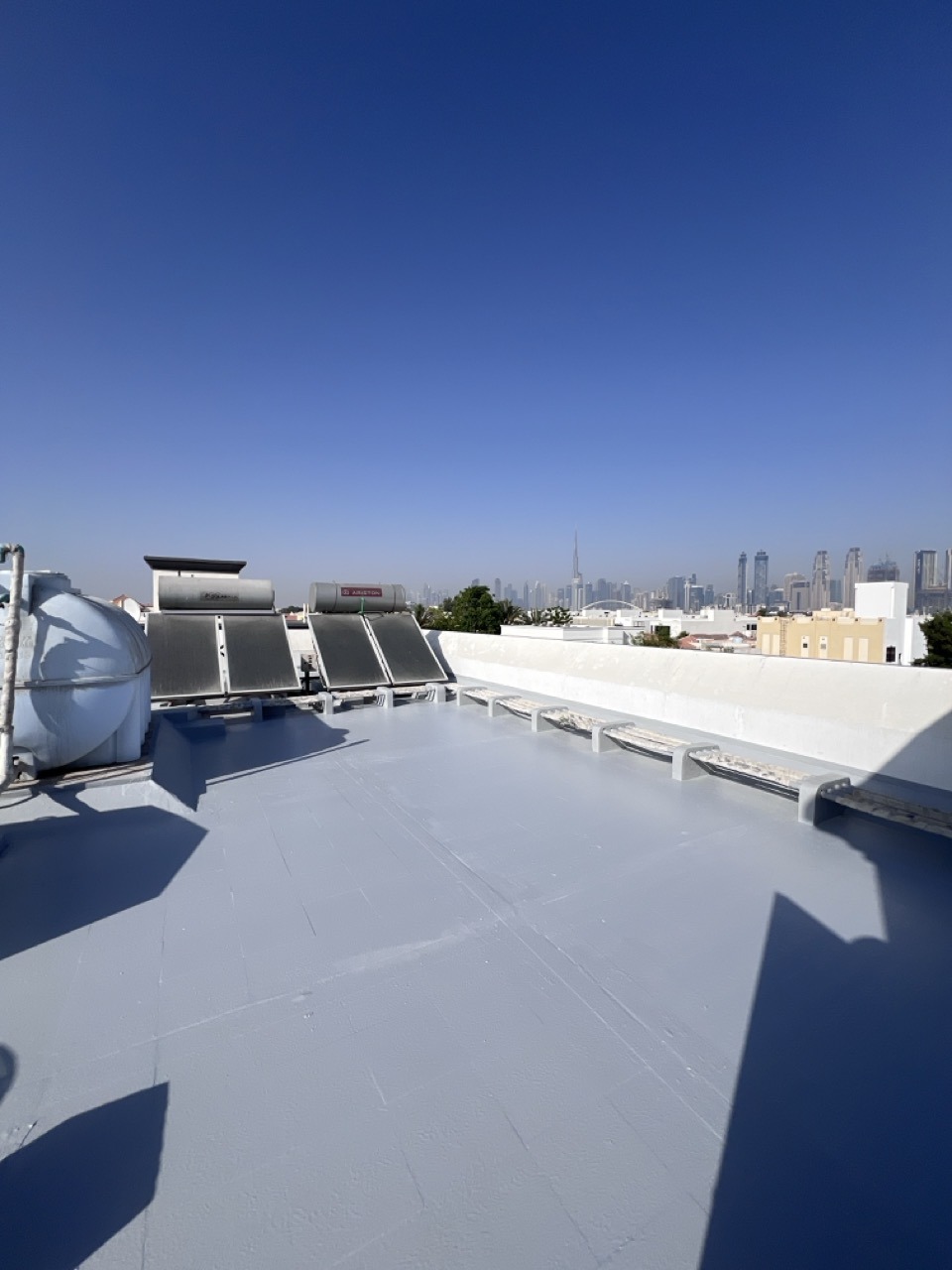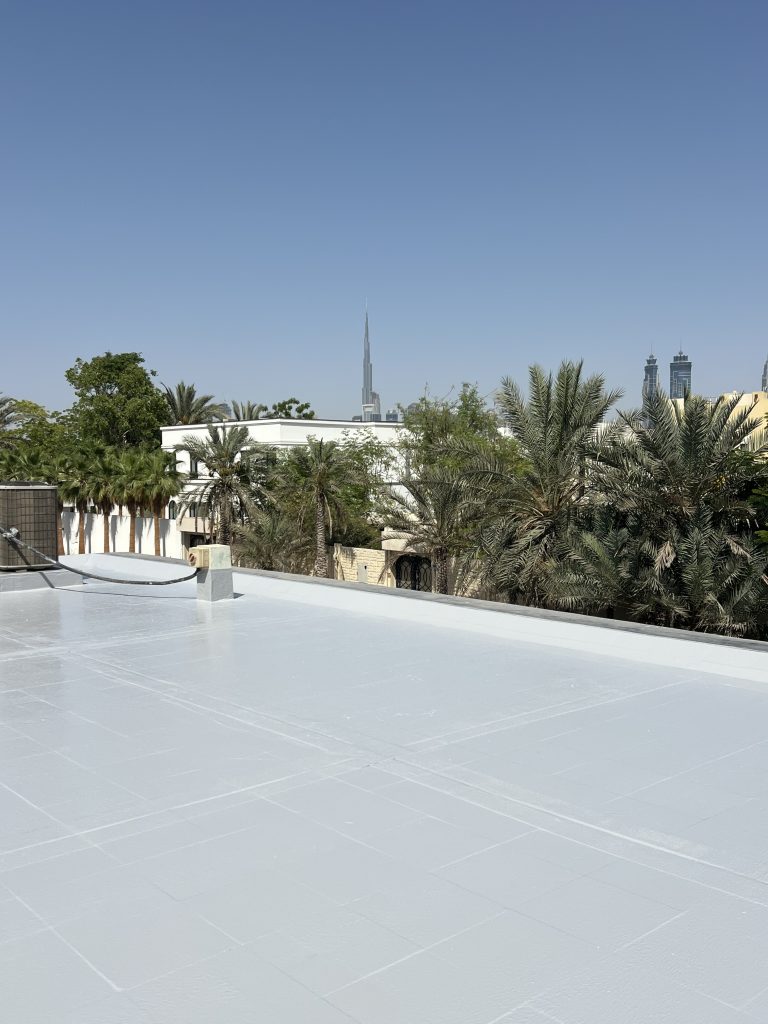
In Dubai the sun does the most damage of all. On a summer afternoon a flat villa roof can reach around 80°C at the surface. That is hot enough to soften some materials, to crack others, and to age a roof faster than anything else. Good roof heat protection in Dubai is not only about a cooler house. It is about protecting the waterproofing that keeps the roof standing for years.
This guide explains why roofs get so hot here, what that heat does over time, and the honest options for keeping a roof cooler and protected.
Why Dubai roofs get so hot
Three things work together on a typical villa roof:
- The climate. Long summers, strong direct sun, and very little cloud. The roof takes the full load, hour after hour.
- Flat concrete roofs. Most villas here have flat or low-slope concrete roofs. A flat surface faces the sun directly at midday and holds heat well.
- Dark surfaces. Dark bitumen and grey concrete absorb most of the sunlight that lands on them. A dark roof surface in Dubai can reach around 80°C in summer, while a light, reflective surface stays much cooler.
That heat does not stay on the roof. It moves down into the top floor and pushes the air conditioning harder, all day, every day of the summer.
What roof heat does to a roof over time
Heat is the slow enemy of every flat roof. The problem is not one hot afternoon. It is the cycle, repeated for years:
- Expansion and contraction. The roof heats up in the day and cools at night. It expands and shrinks with every cycle. Over time this movement opens cracks and stresses joints.
- Ageing of the waterproofing. Constant sun and heat make many older coatings and sheet membranes brittle. Brittle material cracks, and a crack is where water gets in.
- Seams and overlaps. Rolled sheet membranes are joined at overlaps. Heat and movement work on those joints first. This is one reason seams are a common failure point.
These are the same faults we see behind most leaks. If you want the full picture, we cover them in our guide to common flat roof problems in the UAE and what causes a roof to start leaking in Dubai.
How a reflective, light-coloured roof stays cooler
The simplest form of roof heat protection is colour. A light, reflective surface sends more of the sun’s energy back into the sky instead of absorbing it. This is the idea behind a “cool roof”. The US Department of Energy and the US Environmental Protection Agency both describe how a reflective roof surface stays cooler than a dark one under the same sun.
In plain terms: a dark roof drinks the heat, a light reflective roof turns much of it away. A cooler roof surface means less heat moving into the rooms below and less stress on the roof itself. For a villa in Dubai, a light-coloured reflective finish is one of the most direct steps you can take.
But colour alone is not a roof. A reflective finish keeps the surface cooler; it does not, on its own, keep the water out. Real roof heat protection has to do both jobs at once.
Roof heat protection that also keeps the water out
This is where our approach differs from a simple coat of paint. We are waterproofing specialists, so we treat heat and water as one problem.
We apply Frankosil 1K, a liquid waterproofing membrane, Made in Germany. It is applied as a liquid and cures into one seamless layer across the whole roof. Because it is seamless, there are no overlaps and no joints for heat and movement to attack. A light, reflective finish can then keep the surface cooler while the membrane underneath does the waterproofing.
The result is a roof that is protected against both the heat and the rare but heavy Dubai rain, from the same system. We stand behind it with a 20-year warranty, and we have completed 1,500+ projects across Dubai and the UAE. You can see examples of finished roofs on our project showcase.
Signs your roof is losing the fight with the heat
You do not need to wait for a leak. These are early signs that heat has started to damage the roof surface:
- The waterproofing looks cracked, chalky, or brittle when you look closely.
- The coating has lifted, bubbled, or peeled in patches.
- Old joints or overlaps have opened.
- The top floor is noticeably harder to cool in summer than it used to be.
- You can see fine cracks in the concrete around the edges and around pipes.
Catching these early is far cheaper than repairing water damage later. A simple seasonal check, like the one in our villa roof maintenance guide, will usually show the first signs.
What we check on a free site inspection
Every roof is different, so we start by looking at yours. On a free inspection we check the current surface, the condition of the existing waterproofing, the drainage, the joints, and the areas around pipes and edges. Then we explain, in plain language, what will keep your roof cooler and watertight, and what it involves.
No obligation and no pressure. Book a free site inspection and we will come and look at your roof.
Frequently asked questions
How hot does a roof get in Dubai?
A flat villa roof surface can reach around 80°C on a summer afternoon. Dark surfaces get hotter than light ones. That heat is the main reason roofs age and waterproofing fails here.
Does a cool or reflective roof coating really lower the temperature?
A light, reflective surface reflects more sunlight than a dark one, so the roof surface stays cooler. Energy authorities such as the US Department of Energy describe this well-established effect. A cooler surface also means less stress on the roof over time.
Is a reflective coating the same as waterproofing?
No. A reflective finish helps with heat, but it does not on its own keep water out. For real protection you need a proper waterproofing membrane underneath, with a reflective finish on top. We apply both as one system.
Will roof heat protection lower my cooling bills?
A cooler roof surface means less heat entering the top floor, which reduces the load on the air conditioning. The exact saving depends on your villa, its insulation, and how you use it, so we do not promise a fixed number. What we can promise is a roof that is both cooler and watertight.
Can you add heat protection to a roof that is already waterproofed?
It depends on the condition of the existing waterproofing. If it is sound, a light reflective finish may be an option. If it is cracked or ageing from the heat, it is usually better to renew the waterproofing and finish properly in one step. We tell you honestly which one your roof needs after the inspection.
When is the best time to protect a roof from heat?
Before the peak of summer is ideal, but any time is better than after damage appears. A roof already showing cracks or brittle patches should be looked at soon, because heat damage only gets worse.
Heat is the one thing a Dubai roof cannot escape. The right protection turns it from a threat into something the roof can handle for years. Book your free inspection and we will show you what your roof needs.