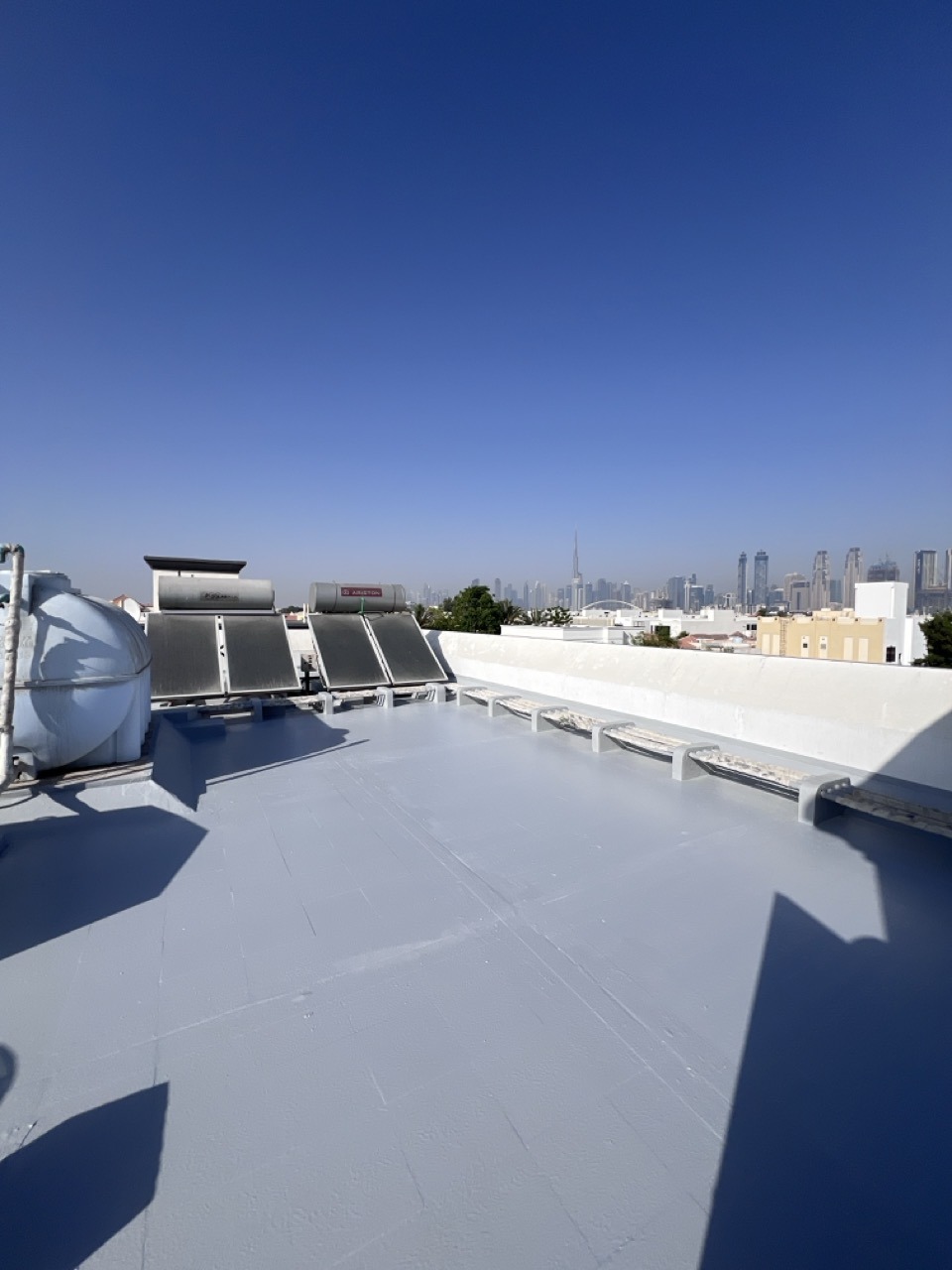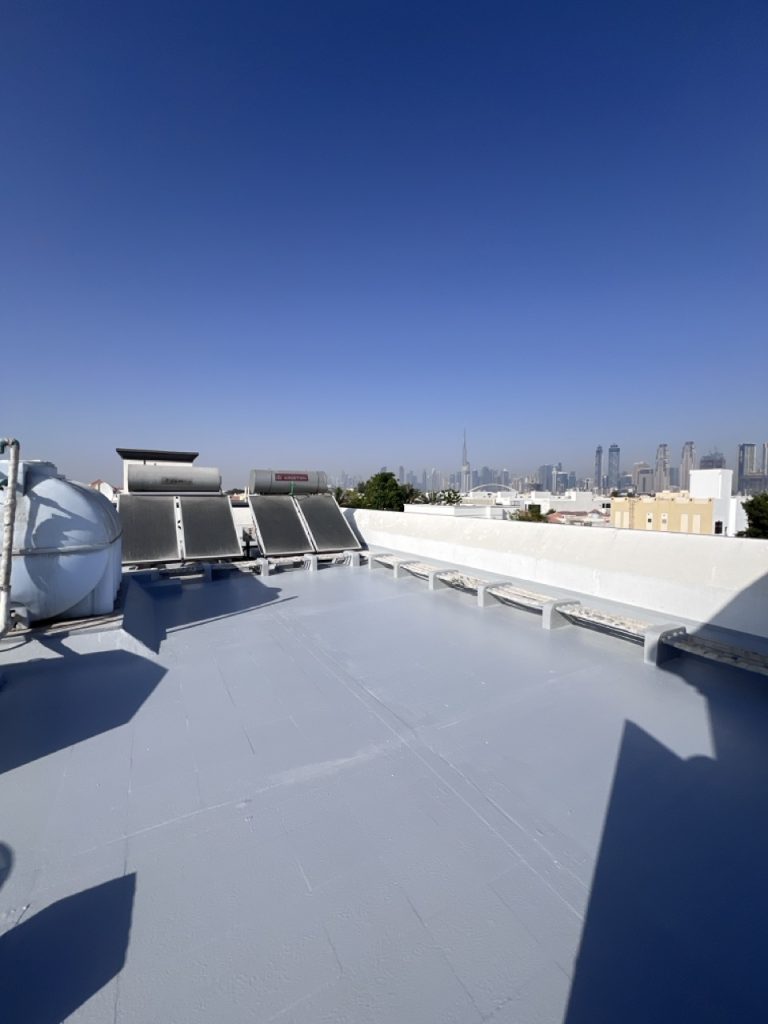
Balcony waterproofing in Dubai is one of the most common repairs we are called out for, and almost always for the same reason. A balcony or terrace is exposed on three sides, it heats and cools every day, and the waterproof layer that should sit under the tiles was either applied badly or never applied at all. The first sign is rarely on the balcony itself. It is a damp patch or a brown stain on the ceiling of the room below.
This guide explains why balconies leak in the UAE, how to tell when yours needs attention, and what proper balcony and terrace waterproofing actually involves. There are no prices here. The first step is always a free site inspection, because every balcony is different.
Why balconies leak in Dubai
A balcony has a harder job than most people think. It is a small, flat, outdoor slab that has to stay watertight while the sun, the rain and the drains all work against it. In Dubai a few problems repeat again and again.
- The membrane under the tiles failed. Real waterproofing on a balcony sits below the tiles, not on top of them. If that hidden layer was skipped, thinned out to save time, or applied without proper detailing, water passes straight through the tile bed and into the slab.
- Blocked or slow drains. Fine desert sand builds up in balcony drains and outlets. Water that cannot drain sits on the surface, finds the weakest joint, and works its way down.
- Cracked grout and open joints. The slab expands in the heat and contracts at night, every single day. That constant movement opens grout lines and cracks the joints between tiles, giving water an easy path in.
- A missing or failed threshold. The step where the balcony meets the door is a classic leak point. Without a proper upstand and sealed threshold, water runs back inside instead of away.
The result is a slow leak that appears as a stain in the room below. If you are seeing that stain now, our guide on a water stain on the ceiling explains how to read what it is telling you.
Signs your balcony needs waterproofing
Balcony leaks are slow, so the early signs are easy to miss. Catching them early is far cheaper than waiting for the ceiling below to fail. Look for these:
- A damp patch, brown stain or bubbling paint on the ceiling of the room directly under the balcony.
- White chalky deposits (efflorescence) on the underside of the slab or on the balcony surface.
- Loose, lifting or hollow-sounding tiles when you tap them.
- Cracked grout lines, open joints, or gaps where the balcony meets the wall.
- Standing water that stays for hours after rain or after the balcony is washed.
- A musty, damp smell in the room below, even when the ceiling still looks dry.
One or two of these together usually means the waterproof layer is no longer doing its job. The damage does not stop at the paint. Left alone, water reaches the steel inside the concrete and the repair grows every year.
How balcony waterproofing works
Proper balcony and terrace waterproofing is not a coating painted over the finished floor. It is a system built into the balcony, and the detailing is where a job is won or lost.
- Preparation. The surface is cleaned and repaired so the membrane bonds to sound concrete, not to dust or loose material.
- Detailing the weak points. Drains, the door threshold, corners and the upstand against the wall are reinforced first. These are exactly the places a balcony leaks, so they are treated before the open field.
- The membrane. A waterproof membrane is applied across the whole surface and turned up the walls to form a watertight tray, so water is held on the balcony and sent to the drain.
- Falls to the drain. The surface is set to fall towards the outlet so water leaves quickly instead of ponding.
The principle is the same one we apply on a roof. If you want the wider picture of how flat surfaces fail in this climate, our guide to flat roof problems in the UAE covers ponding, cracks and failing joints in detail.
Waterproofing under the tiles, or over them
Owners often ask whether a balcony can be waterproofed without removing the tiles. The honest answer depends on the condition of what is already there.
The strongest result is a membrane installed under new tiles, because the waterproof layer sits where it belongs, protected below the finish. Where the existing tiles are still well bonded and sound, a seamless liquid membrane can sometimes be applied over the top as a durable finished surface, with every joint, drain and threshold sealed as part of the work. What does not work is a quick sealant smeared over cracked grout and hoping for the best. There is no surface product that reliably restores a membrane that has already failed underneath. A site inspection is the only way to say which route fits your balcony.
Why the Dubai climate is hard on balconies
This is where the local conditions decide everything. Roof and balcony surfaces in the UAE reach 80 °C in summer. A balcony slab heats up through the day and cools at night, and it expands and contracts every day as it does. That daily thermal movement is what pulls joints apart and opens the hairline cracks that let water in over the years.
Rain makes the point sharply. The UAE gets little rain, but when it comes it can be intense. The National Center of Meteorology records exactly these short, heavy bursts, and a balcony with slow drains and a tired membrane has no defence against them. Between the rare storms, AC condensation and washing keep a steady trickle of water on the surface all year. A balcony in Dubai is never really dry for long.
Why a seamless liquid membrane suits balconies
A balcony is full of weak points: a drain, a threshold, corners, an upstand against the wall, and often a railing fixed through the slab. Every one of those is a place a joint can leak. Older methods that rely on sheet material laid in pieces have to be cut and joined around each of them by hand, and the finished balcony is only as good as its weakest overlap.
A liquid-applied membrane removes that risk. It flows around drains, corners and fixings as one continuous piece, with no seams to work loose as the slab moves. We use Frankosil 1K, a German liquid waterproofing membrane made by Franken Systems, applied seamlessly and reinforced at every detail. It is the same system behind more than 1,500 completed projects across the UAE, and it carries a 20-year warranty. You can see examples of our work in the project showcase.
Do not wait for the ceiling below to fail
A balcony leak is patient. It works quietly through the slab for months before it shows, and by the time a ceiling is stained the water has usually reached the concrete and the steel inside it. Acting on the early signs, a hollow tile, an open joint, a first faint patch below, keeps a small job small. If the room below is already showing damage, our guide on what to do when a roof is leaking in Dubai walks through the first steps to take.
Balcony waterproofing questions
How long does balcony waterproofing last?
A properly installed seamless liquid membrane, with the drains and thresholds detailed correctly, is built to last for decades rather than years. Our Frankosil 1K system carries a 20-year warranty. A cheap surface coating over cracked grout, by contrast, often fails within a season or two.
Can you waterproof a balcony without removing the tiles?
Sometimes. If the existing tiles are still well bonded and the substrate is sound, a seamless liquid membrane can be applied over them with all the joints, drains and thresholds sealed. If the tiles are loose or the membrane below has already failed, the surface has to be taken up so the problem is fixed at the source. Only a site inspection can tell which case yours is.
What causes a balcony to leak in Dubai?
Usually a missing or failed membrane under the tiles, made worse by sand-blocked drains, cracked grout from daily heat movement, and an unsealed door threshold. Water finds the weakest of these and travels down into the room below.
Do covered balconies need waterproofing?
Yes. A roof or shade over a balcony reduces direct rain, but it does not stop AC condensation, washing water, or the slab moving in the heat. Covered balconies still leak, and they are often ignored until the damage is advanced.
How do I know if my balcony has a waterproof membrane?
You usually cannot see it, because a proper membrane sits under the tiles. The clues are indirect: a balcony that has never leaked, drains cleanly, and shows no staining below has likely got one working. Recurring stains in the room underneath are a strong sign that it is missing or has failed.
How often should a balcony be waterproofed?
With a quality seamless membrane, a balcony should not need redoing for many years. The practical habit is a quick check before the winter rain season each year: clear the drains, look for cracked grout or lifting tiles, and check the ceiling below for any new mark. Small problems caught early rarely become large ones.
Book a free balcony inspection
If your balcony is staining the ceiling below, holding water, or you simply want to know whether it is protected before the next rain, the first step is a free site inspection. One of our specialists checks the surface, the drains and the thresholds, and tells you honestly what is happening and what it needs. Book a free site inspection here.